
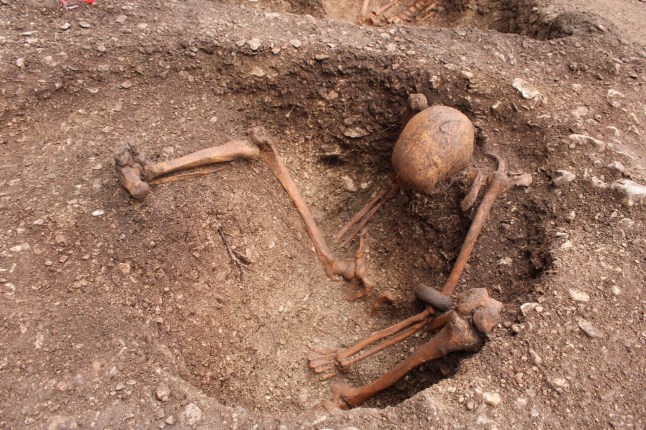
One of the seated skeletons in the burial site in Dijon. Several showed signs of violence and all are likely to have been men aged between 40 and 60 (Picture: Hervé Laganier/Inrap/Cover Media)
Archaeologists have uncovered 13 skeletons sitting upright in an ancient burial ground in France.
The site is in the former garden of the Cordeliers convent in Dijon and is believed to date from the second Iron Age (400BC to 100BC).
Horrifyingly,investigators also identified a Gallo-Roman necropolis from the 1st Century AD,containing the remains of around 20 infants who are thought to have died before reaching their first birthday.
The upright skeletons were placed in 13 circular burial pits,each about one metre in diameter,arranged in a straight north–south line over a distance of 25 metres.
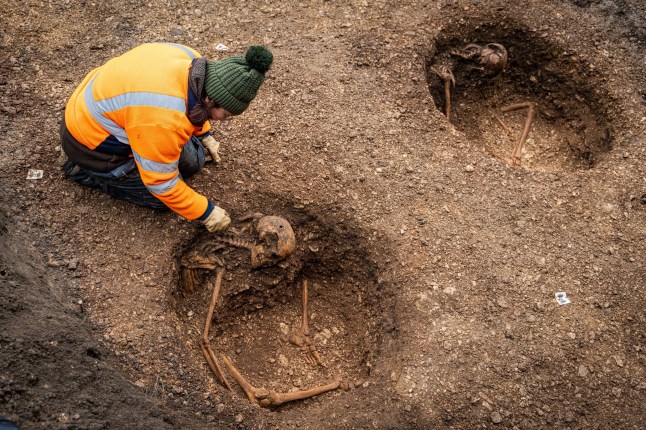
An archaeologist examines one of the circular pits,which were in the garden of a former convent (Picture: Christophe Fouquin/Inrap/Cover Media)
A further five or six burials uncovered in a later phase of excavation appear to follow a similar pattern. Despite erosion,many of the remains are well preserved.
Initial analysis of the 13 seated individuals suggests they were all men aged between 40 and 60,standing between 1.62m and 1.82m tall.
Researchers say they appear to have been in relatively good health,showing signs of physical activity and strong teeth.
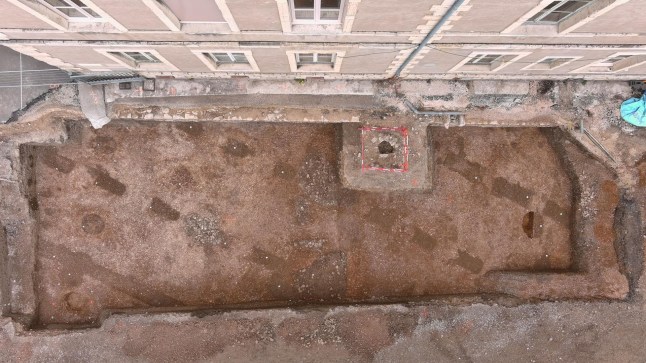
An aerial view of the excavation. The remains of 20 babies were also found (Picture: Jérôme Berthet/Inrap/Cover Media)
However,several skeletons bear evidence of violence. Five or six show unhealed injuries,including cuts to the upper arm bone,suggesting they may have been deliberately killed.
One individual appears to have died after receiving two blows to the skull from a sharp weapon.
The bodies were buried in a consistent manner: seated at the base of the pit,backs against the eastern wall and facing west. Their arms were placed alongside their bodies,with hands near the pelvis or thighs,and their legs tightly bent.
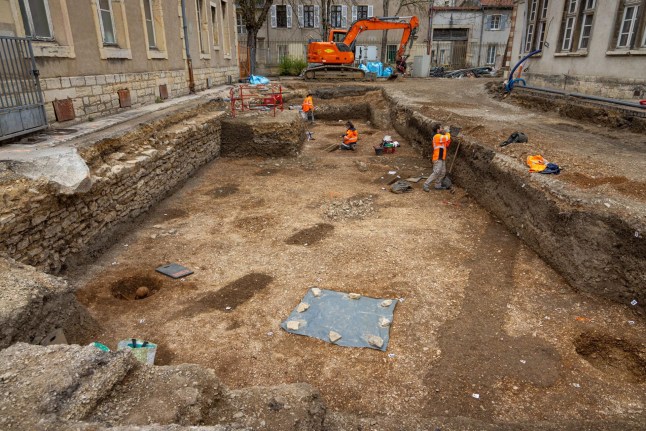
The seated skeletons date from the Second Iron Age and investigators will examine them to find out more about their lives(Picture: Christophe Fouquin/Inrap/Cover Media)
Aside from a single black stone armband dated between 300 and 200 BC,no personal objects were found.
Experts say the findings contribute to growing evidence of a structured Gallic settlement in the area prior to the Roman era.
The discovery on Rue Turgot is considered particularly significant due to both the number of burials uncovered and the condition in which they have been preserved.
Disclaimer: This article is reproduced from other media. The purpose of reprinting is to convey more information. It does not mean that this website agrees with its views and is responsible for its authenticity, and does not bear any legal responsibility. All resources on this site are collected on the Internet. The purpose of sharing is for everyone's learning and reference only. If there is copyright or intellectual property infringement, please leave us a message.
©Copyright 2009-2020 Startup Weekly Contact Us SiteMap
